
University of Bonn – New Building for the Institute for Molecular Biology (ImBIG)
Client
Building and real estate management company in North Rhine-Westphalia
Competition 1st prize
2025
Start of planning - Completion
2026 - 2034
Project Stages
2 - 8
General Planning
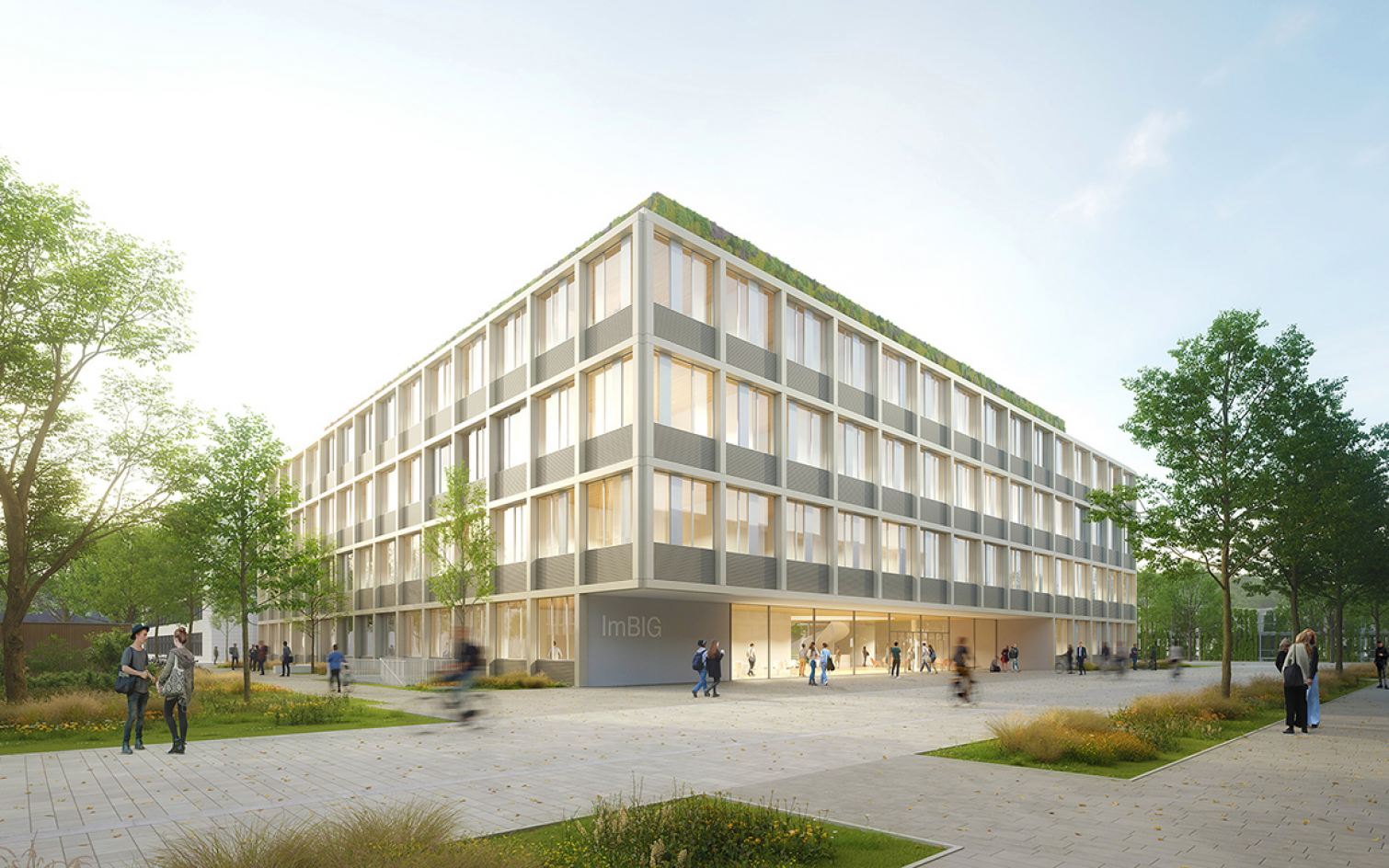
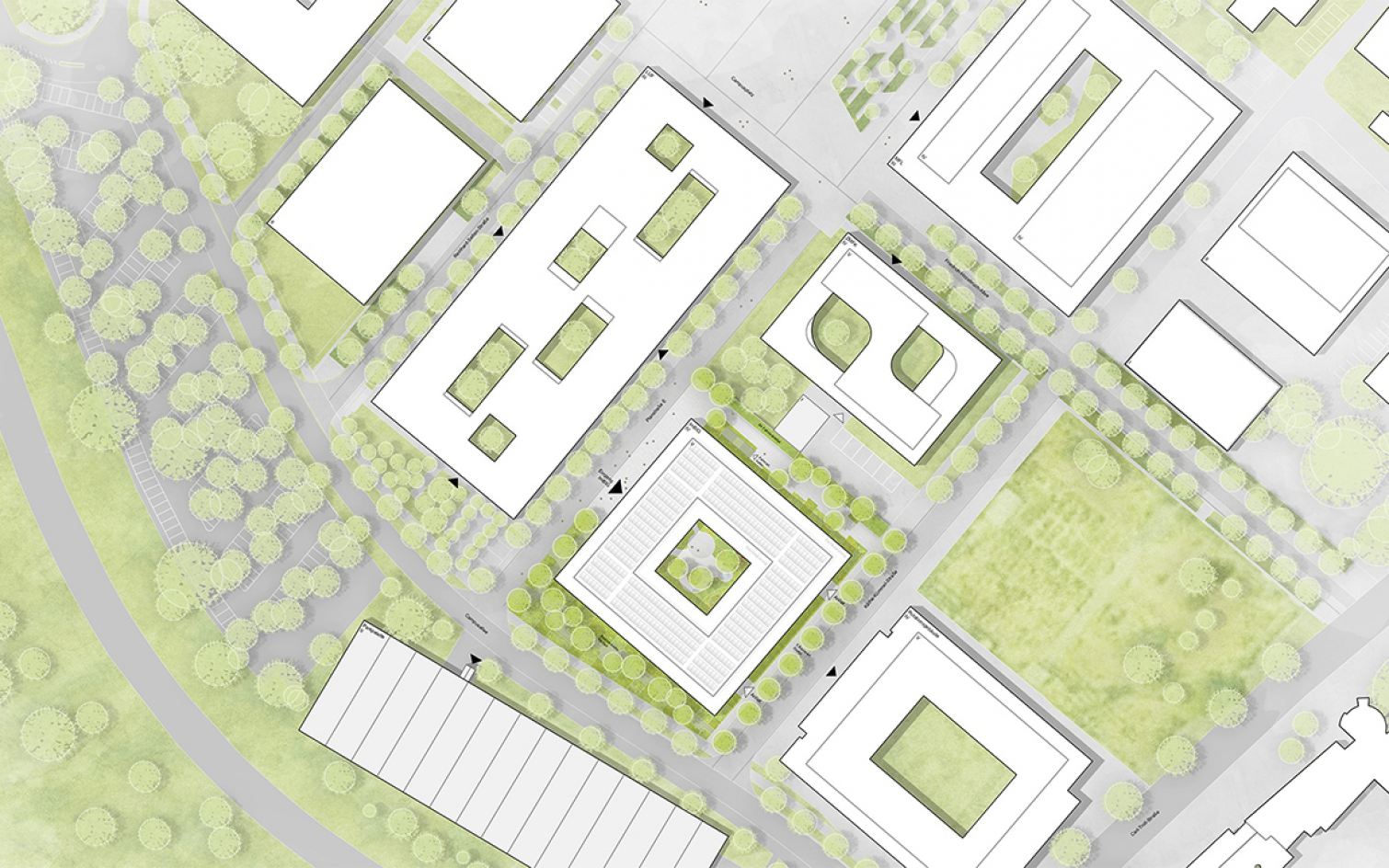
The future Institute of Molecular Biology (ImBIG) is located at the southern edge of the Poppelsdorf campus. The proposed compact building volume aligns in its number of storeys and typology with the neighboring research buildings (ZFMK and the Rotations Building) and deliberately differentiates itself from the three-storey Teaching and Research Forum (LUF). This distinction emphasizes the LUF’s functional and urban significance while allowing the new building to integrate more strongly into the surrounding landscape of institutes.
The main entrance of the new building faces Planstraße E and the central campus square. Deliveries and services are handled from the opposite side via Käthe-Kümmel-Straße.
The surrounding development and the already realized open spaces in the immediate vicinity of the construction site for Molecular Biology create very different spatial qualities to which the new building must respond. As a result, attractive green spaces are created on the north, east, and south sides to buffer external influences such as noise from the nearby motorway, the delivery yard of the zoological research facilities, and the entrance area of the Rotations Building. To the west, the main entrance of the new building opens onto a plaza that forms an expansion of the paved public space. This plaza serves as a point of address and maintains a visual connection to the campus square to the north.
Directly adjacent to the main entrance, the ground floor accommodates the high-traffic seminar and practical teaching areas. The workshop is located on the delivery side and is easily accessible via a secondary entrance on Käthe-Kümmel-Straße.
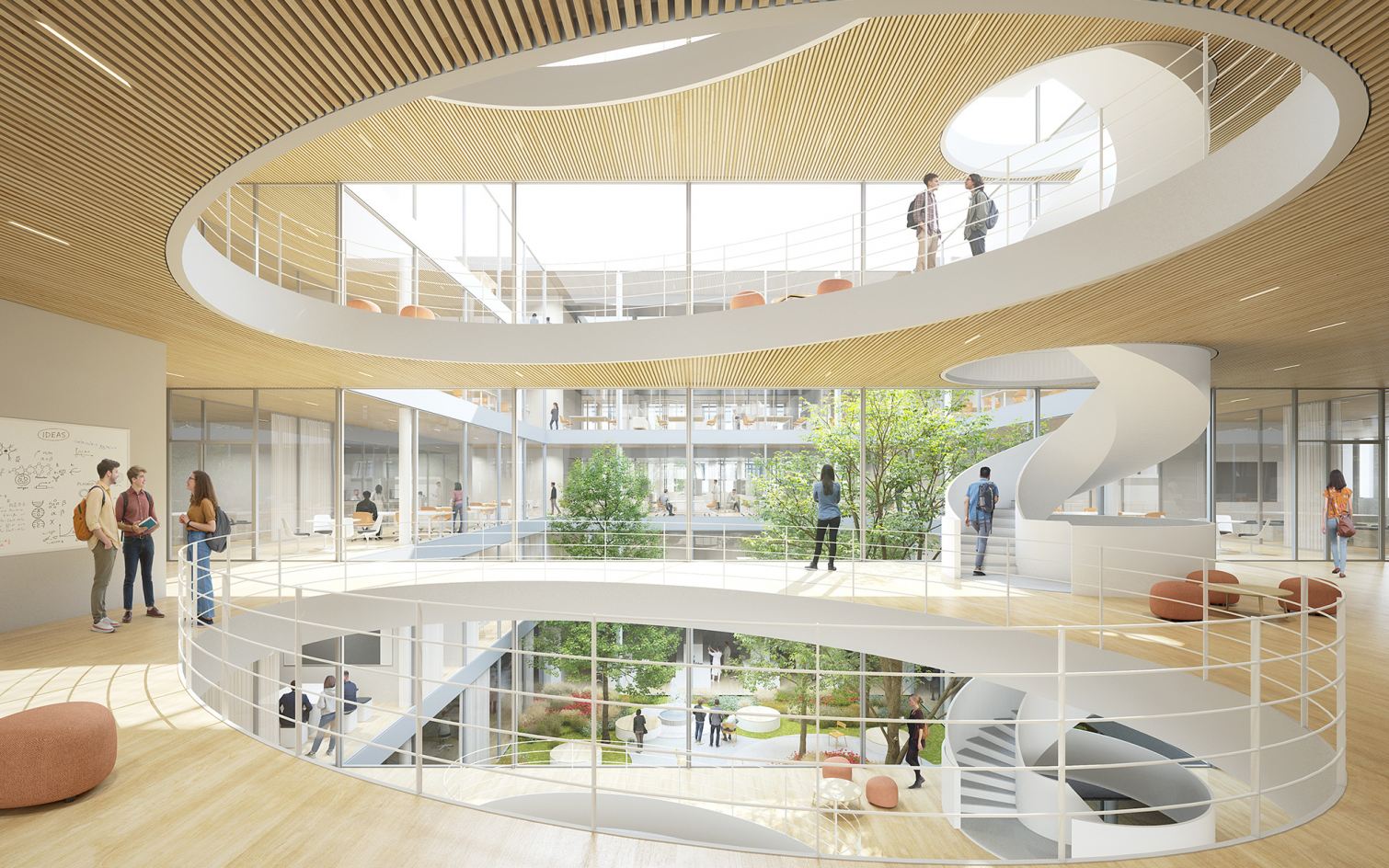
A central staircase in the foyer provides access to all other floors. While the specialized laboratories for cell culture and microscopy are located in the basement, the remaining laboratories and offices are distributed across the three upper levels. These floors share an identical basic layout, with office areas on the west side and laboratory spaces on the east side.
The heart of the building is a ring of circulation and communication spaces surrounding a landscaped inner courtyard. This “loop” contains, in addition to the central vertical circulation, student workstations, meeting rooms, and evaluation and documentation areas. It is intended to encourage informal encounters and enable optimal knowledge exchange within the building.